
Market Appraisal vs Red Book Valuation: What every Worcestershire commercial property owner needs to know

If you own commercial property in Worcestershire, whether that's a unit on Shrub Hill Industrial Estate, a retail premises in the Shambles, or agricultural buildings out towards the Vale of Evesham, there's a good chance you've been asked (or will be asked) for a "valuation" at some point.
But here's where it gets confusing, not all valuations are the same thing. In fact, there are two very different types that get mixed up all the time, and choosing the wrong one could cause you real headaches down the line.
Let's break it down.
What is a Market Appraisal?
A market appraisal, sometimes called an agent's value, is an informal estimate of what your property is likely to achieve on the open market at any given time.
Think of it as professional guidance from someone who knows the local market inside out. It draws on comparable evidence: recent lettings, sales, current demand, and a healthy dose of local knowledge about what's happening across Worcestershire's commercial property landscape right now.
When is it used?
You're thinking about selling or letting and want to understand where to pitch the asking price
You're reviewing your property portfolio and want a sense of current asset values
You're in early-stage discussions with a lender or investor and need a ballpark figure
You want to understand whether now, is a good time to bring your property to market
A market appraisal is typically provided free of charge by a commercial property agent as part of the process of them hopefully being instructed to market your property. It's a commercial conversation, not a regulated, legally binding document.
What it isn’t - It isn't a formal, independently verified valuation. It won't be accepted by a bank, a court, HMRC, or any formal third party that requires a regulated opinion of value.
What is a Red Book Valuation?
A Red Book valuation, formally known as a RICS Valuation, is a formal, regulated assessment of your property's value carried out by a qualified RICS (Royal Institution of Chartered Surveyors) Registered Valuer in strict accordance with the RICS Valuation Global Standards (commonly known as the "Red Book").
This is the gold standard of property valuation. It is comprehensive, independently verified, and carries professional indemnity insurance. The valuer must follow a rigorous methodology, declare any conflicts of interest, and produce a detailed written report that stands up to scrutiny.
When is a Red Book Valuation required?
Securing finance: Banks and lenders will almost always require a Red Book valuation before advancing funds against commercial property
Buying or selling with legal certainty: Where a formal, defensible value is needed for due diligence
Probate and inheritance tax: HMRC requires a formal valuation for estate purposes
Pension fund acquisitions: If your SIPP or SSAS is acquiring commercial property, a Red Book valuation is mandatory
Dispute resolution and litigation: Courts and arbitrators require regulated valuations
Lease renewals under the Landlord and Tenant Act: Formal rent review or lease renewal disputes
Accounting and financial reporting: Auditors require RICS-compliant valuations for balance sheet purposes
Compulsory purchase: If your property is subject to a CPO, you'll need formal evidence of value
A Red Book valuation is a paid professional service, and takes time, expertise, liability, and regulatory compliance.
The key differences between a Market Appraisal and a Red Book Valuation
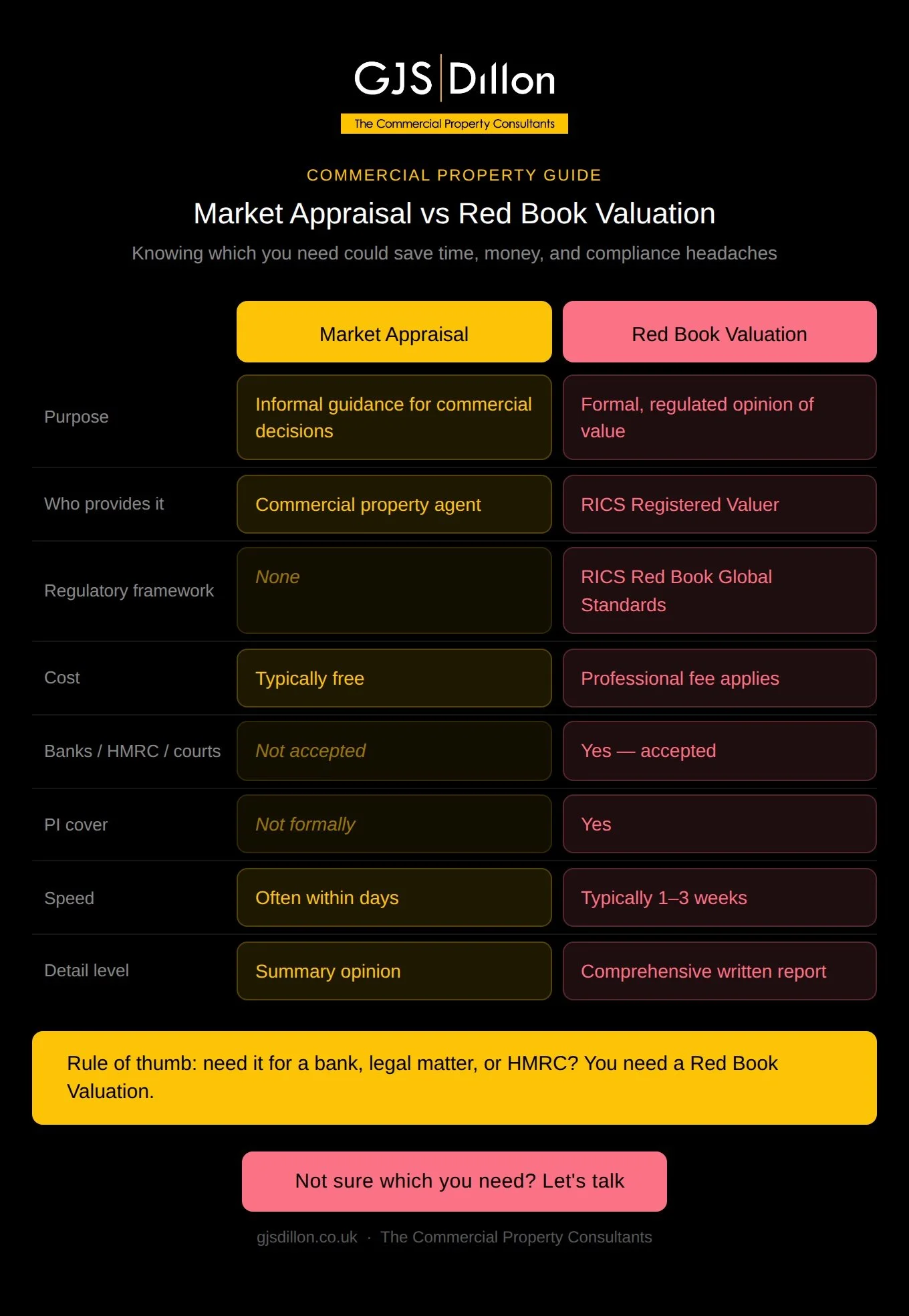
Which one do you need?
You need a Market Appraisal if you are:
Thinking about selling or letting and want to understand where the market sits
Having early conversations with potential investors or partners
Reviewing your portfolio value informally
Simply curious about what your property might be worth today
You need a Red Book Valuation if you are:
Securing any form of debt finance against the property
Dealing with HMRC, probate, or legal proceedings
Acquiring property through a pension scheme
Involved in any formal dispute or lease renewal
Required by an auditor or accountant for financial reporting
A common mistake we see
A commercial property owner in Worcestershire decides to remortgage their commercial premises to release equity. They receive a market appraisal from their agent at a value of £650,000, so they then approach their bank.
The bank says: "We need a Red Book valuation."
The owner has to commission a formal valuation, which comes back at £590,000, a different figure, reflecting the rigorous methodology and market evidence required under RICS standards. The loan offer is based on the lower figure.
This is why each tool does a different job. The market appraisal gives a useful market steer and the Red Book valuation gives a defensible, lender-grade number.
How we can help
As commercial property consultants based in Worcestershire, we work with property owners across the county every day, helping them understand their assets, make informed decisions, and navigate everything from lettings and disposals to formal valuations and strategic asset reviews.
If you're unsure whether you need a market appraisal or a Red Book valuation, or if you'd simply like an honest conversation about where your commercial property sits in today's market, we'd be delighted to help.